- Plenty of cardboard
- Something to cut it with
- Clear tape (or any tape with a smooth, non-absorbant surface)
- Salad bowl used in Phase I
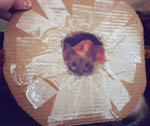 Now that the cat has grown accustomed to
going in the salad bowl filled with litter, it is now time to separate the
cat from its litter. To do this, cut
a cardboard platform to fit over the salad bowl (but still under the toilet
seat), and cut a hole in the center of it about 4-5 inches in diameter,
depending on the size of your cat. The hole should be big enough for it
to stick its head and front paws into it, but not its entire body. Use clear
tape to "seal" the cardboard, so that it does not absorb urine when the cat
misses, because the cat is likely to miss often. An example of this is shown
to the left (Allegro says, "Hi mom!"). I recommend using enough tape to cover
the entire
surface area, not just the center as the example shows to the left. If there
is one square millimeter that you miss, your cat's urine will find it.
Trust me.
Now that the cat has grown accustomed to
going in the salad bowl filled with litter, it is now time to separate the
cat from its litter. To do this, cut
a cardboard platform to fit over the salad bowl (but still under the toilet
seat), and cut a hole in the center of it about 4-5 inches in diameter,
depending on the size of your cat. The hole should be big enough for it
to stick its head and front paws into it, but not its entire body. Use clear
tape to "seal" the cardboard, so that it does not absorb urine when the cat
misses, because the cat is likely to miss often. An example of this is shown
to the left (Allegro says, "Hi mom!"). I recommend using enough tape to cover
the entire
surface area, not just the center as the example shows to the left. If there
is one square millimeter that you miss, your cat's urine will find it.
Trust me.
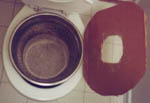 Next, tape the
cardboard to the salad bowl on one side (firmly - use lots of tape) so that
it will not move when your cat walks on it, but also so that you can open the
cardboard "lid" to clean out litter clumps from the bowl. An example of this
is shown to the right.
Next, tape the
cardboard to the salad bowl on one side (firmly - use lots of tape) so that
it will not move when your cat walks on it, but also so that you can open the
cardboard "lid" to clean out litter clumps from the bowl. An example of this
is shown to the right.
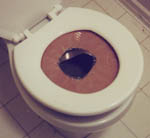 Put the salad bowl back inside
the toilet bowl as you did in Phase I,
only now you also have a cardboard platform between the salad bowl and the
toilet seat. This is shown to the left.
Put the salad bowl back inside
the toilet bowl as you did in Phase I,
only now you also have a cardboard platform between the salad bowl and the
toilet seat. This is shown to the left.
 You still want the cat to be able to dig in the litter (this is the only
reason the cat will be willing to continue going in the same place), but
the key is that the hole
is small enough so that the cat cannot go while standing in the litter.
The cat must first dig a hole in the litter by standing on the cardboard
platform, then it will naturally want to aim so that its excrement goes into
the hole it digged (thus forcing it to aim for the hole in the platform). The
cat may not be successful at aiming - don't panic. Let the cat miss. You
don't want to scare or confuse the cat by trying to move it around while it
goes. That is why we taped the cardboard platform - the mess should be easy
to clean up.
You still want the cat to be able to dig in the litter (this is the only
reason the cat will be willing to continue going in the same place), but
the key is that the hole
is small enough so that the cat cannot go while standing in the litter.
The cat must first dig a hole in the litter by standing on the cardboard
platform, then it will naturally want to aim so that its excrement goes into
the hole it digged (thus forcing it to aim for the hole in the platform). The
cat may not be successful at aiming - don't panic. Let the cat miss. You
don't want to scare or confuse the cat by trying to move it around while it
goes. That is why we taped the cardboard platform - the mess should be easy
to clean up.
If the cat does not immediately adjust to this new platform and it doesn't
want to go (which is pretty likely - mine didn't), again you can revert back
to the strategies mentioned at the end of
Phase I. You should still take
one of the cat's front paws and dig it into the litter a few times so that it
knows it's available for digging. You might also consider doubling up the
cardboard platform so that it's not so flimsy. After one person couldn't get
her cat to go on the toilet when the cardboard was there, she tried doubling
up the cardboard, and the cat was no longer afraid of the flimsy surface.
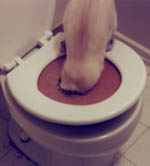
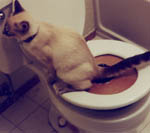 Again, I would like to emphasize not to worry if the cat
misses the hole. All you care about is that the waste lands somewhere inside
the toilet seat. As you see to the left, my cat actually preferred standing
on the toilet seat, probably because he didn't like the flimsy cardboard, and
this caused him to miss the hole every time. It was a pain to always clean
up, but in the long run, it was a blessing since my cat was already
accustomed to standing on the toilet seat while going.
Again, I would like to emphasize not to worry if the cat
misses the hole. All you care about is that the waste lands somewhere inside
the toilet seat. As you see to the left, my cat actually preferred standing
on the toilet seat, probably because he didn't like the flimsy cardboard, and
this caused him to miss the hole every time. It was a pain to always clean
up, but in the long run, it was a blessing since my cat was already
accustomed to standing on the toilet seat while going.
Remember that when a cat is fully toilet-trained and
going to the bathroom using just the toilet seat, the only possible way it
can balance itself is to stick its rear end well over the water in the toilet
(while its head is pretty much over the toilet seat). The cat will never go
on the toilet seat itself unless it does so on purpose. In that case,
training would need to go back a step or two.
Once the cat has gone successfully on its own 2-3 days in a row in the whole
or on the platform, go on to Phase 3.